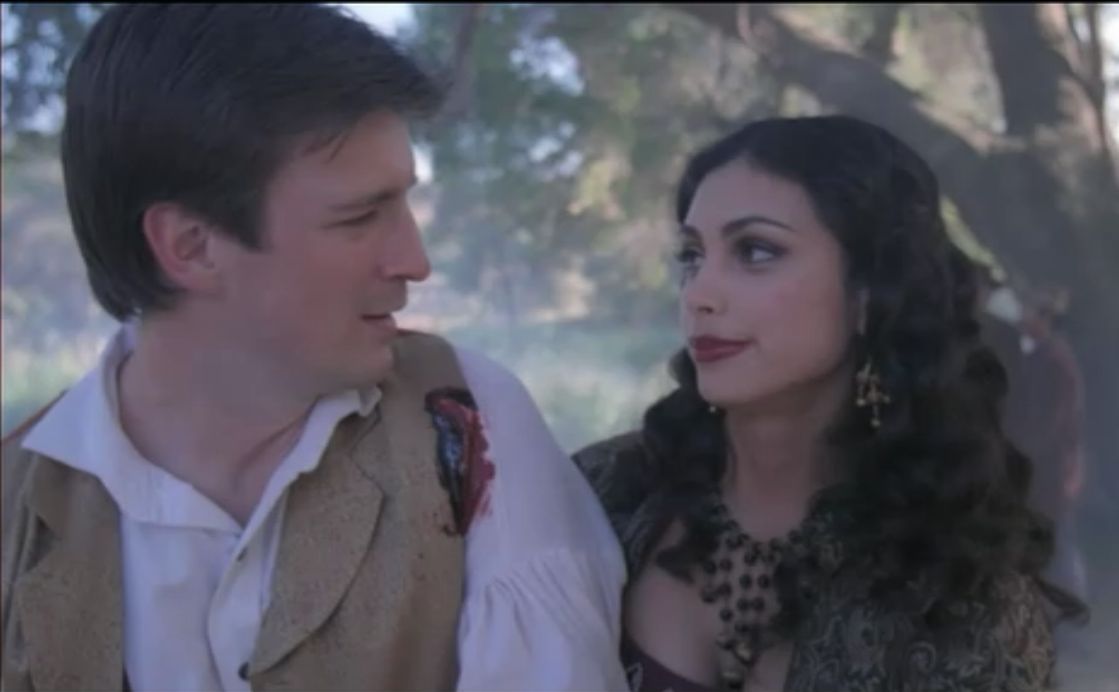
Alright, Tanzi is back running the show for this episode and we have a bit of a disagreement on spoiler policy. Actually we’re not that far apart but my philosophy is the damn show has been off the air for years and there’s only 14 episodes. If you’re reading about these episodes and haven’t seen them yet, well you only have yourself to blame if something slips out. That’s not to say we’re going to intentionally reveal surprise moments or go out of our way to give away the plot but we need a little elbow room to talk about what happens on these shows.
OK, now that I’ve scared off the spoiler police let’s get down to it. Last week my compadres expressed mixed feelings about “Bushwhacked” so now it’s my turn to feel a bit out of sorts about an episode. The episode starts off fine with Mal and Jayne getting in a noble brawl with some slavers and the crew heading to the inner planet Persephone for some refueling and job hunting, plus a little R&R. We’re thrown a bit of a curve however: instead of the expected action and adventure everything slows down a few notches as we join Inara and her client in a fancy dress ball straight out of Sense & Sensibility. I have to admit that I was seriously thinking of bailing on this episode until things heated up between Mal and Atherton. I’m just not interested in the frippery of society ball and there really weren’t any interesting sub plots happening with the rest of the crew. Plus the whole thing reminded me of a Star Trek: TNG holodeck episode. We’re in space, I want to see space stuff, not a ballroom dance.
ScottD: This episode is pretty much for the ladies, all right, with its mix of romance novel and Regency Ball-intrigue elements. Due to the network’s juggling of the release order of the series, after the word-of-mouth built this may have been the first episode many people saw and I’m not sure what people watching the series for the first time may have gotten from it.
But on the way to the dance, this episode does give us some more insight into how this society works when you’re not bucketing around on the fringes. While Persephone may not be one of the high-falutin’ Core planets it still seems to be more fancified than most of the moons near the Border, but there are still things that suggest it is near the frontier. There are Alliance troops on the street (a redress of a backlot street we have seen many times over the years) who take no notice that Mal, Zoe and Jayne are openly packing, and Badger’s men tote automatic weapons with the Feds just down the street. But Persephone also has an upper class with a structured hierarchy at least partly based on nobility.
ScottP: I’d say this is one of the lesser episodes for me as well, although I like it better than “Bushwhacked” (see our post on that one for my reasons). I disagree with Tanzi about “Shindig” in general though — I think as a character-driven episode, it delivers some good stuff. Mal’s barely-contained glee at the knowledge that a brawl is coming with the slavers in the opening sequence is great, for one thing. Jayne is obviously in it for the fight itself, but Mal sees it as a duty, of sorts (not to mention a good time).
Tanzi: This episode saw the return of Mark Sheppard as Badger, the Cockney crime lord of Persephone. I know everyone loves to see Sheppard pop up, he’s been on pretty much every sci fi show of the last 10-15 years, but with his over the top accent I kept expecting to hear a pitch for Geico.
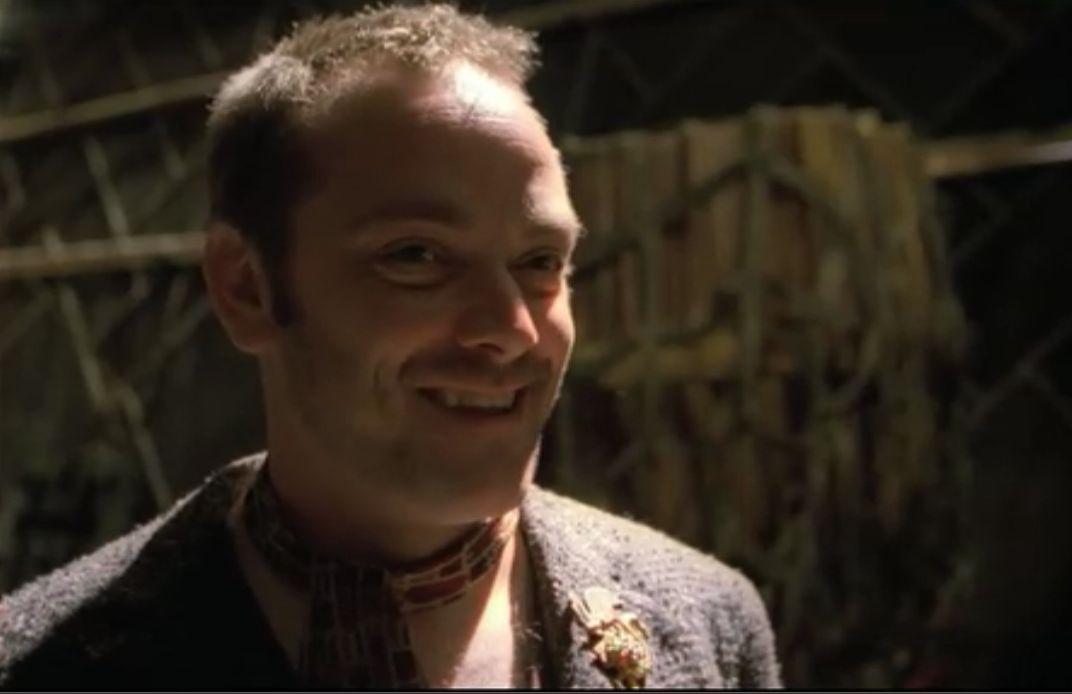
"A penny for the pretty lady."
ScottD: I like to think of Badger as Dickens’ Artful Dodger, all grown up and taking Fagin’s teachings out into space.
Badger’s presence on Serenity sets up one of the nicest bits in the series: River’s dressing down of Badger, complete with mimicry of his accent. We start to realize the depths of this confused girl as she shows her great, somewhat spooky, insight into his character and background. Some nice acting from Summer Glau, who reportedly has quite a talent for accents.
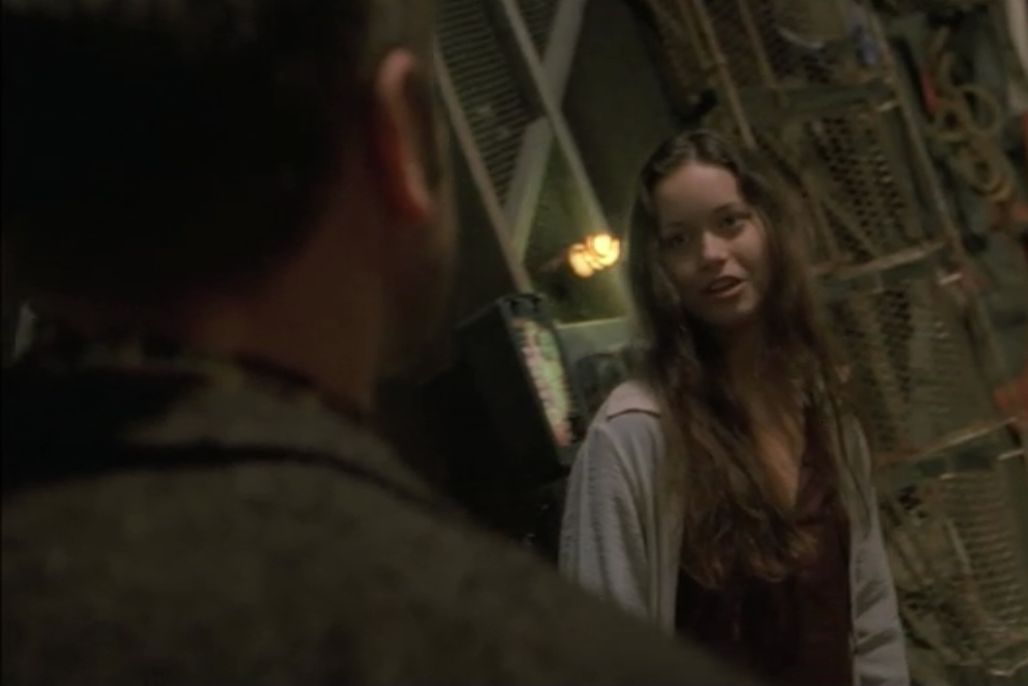
"Sure, I got a secret. More'n one."
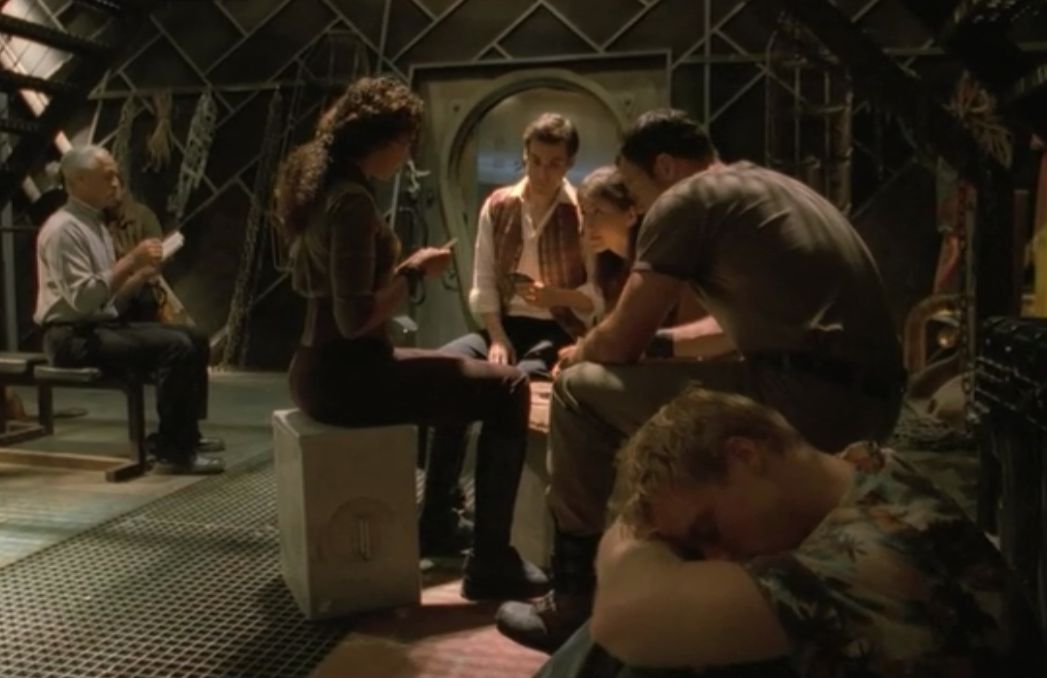
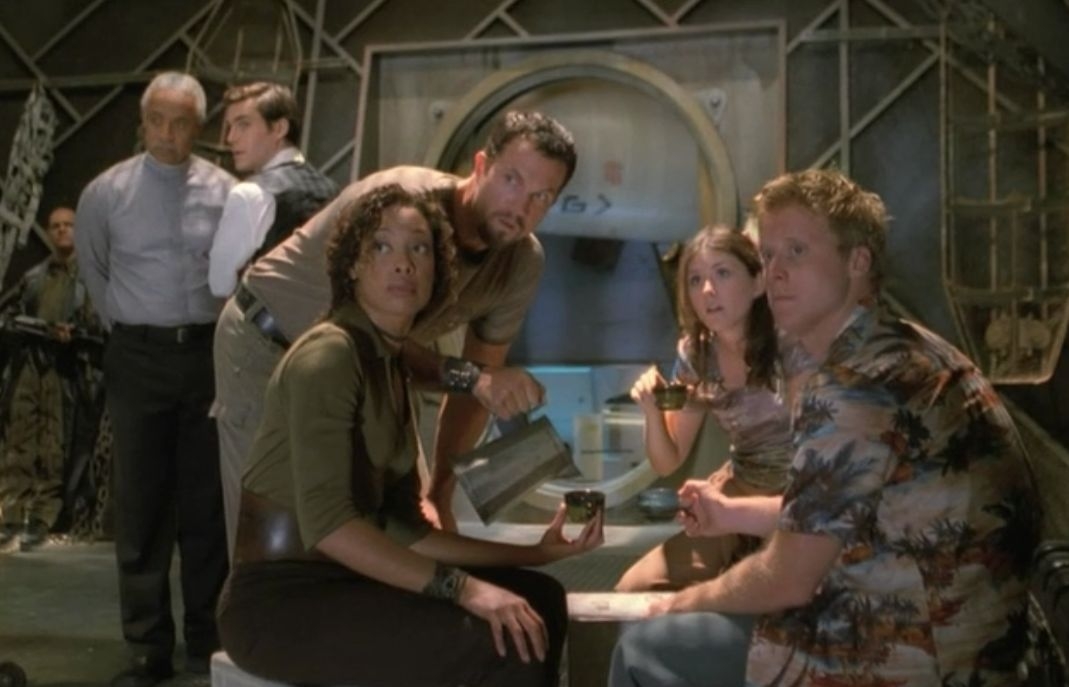
While this episode is heavily about the Mal & Inara romance-novel scenario, there is actually a lot going on about the rest of the characters. We see them for the first time treating each other like fellow crewmembers, first as they play cards and then as they plan a rescue attempt, with even Jayne and Simon working together. (It is interesting to note that it is Simon who immediately starts planning a rescue, and suggests the plan to overcome Badger’s men.) That the plotted rescue never occurs is less important than the fact that they are working as a team, but it does point up how they typically rely on Mal for direction.
Tanzi: Badger recruits Mal to attend the ball in order to convince a wealthy Lord to do business with him, and Mal takes Kaylee along as his escort.
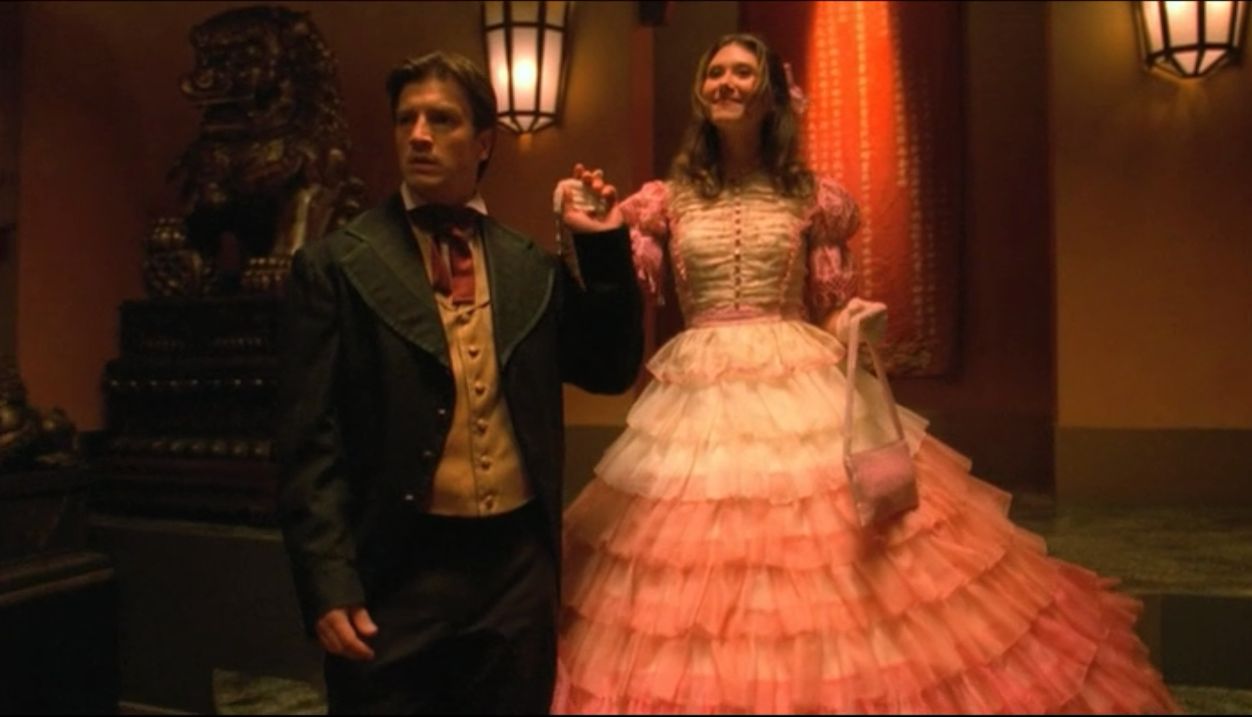
"Miss Kaywinnit Lee Fry, and escort."
ScottD: Mal is unable, as a captain and a cowboy, to tell Kaylee that he is sorry for mocking her. But he tries to make it up to her by buying her the dress and taking her to the party. Classic cowboy behavior.
Tanzi: One of my favorite scenes was Kaylee attracting a lot of male attention by talking about ships and engines. She’s so likable and cute that something as minor as a cross word from Mal or the snottiness of the society girls comes off as truly devastating so it was nice to see her bounce back so quickly.

"I'm not saying the eighty-oh-four's hard to repair, it just ain't worth it."
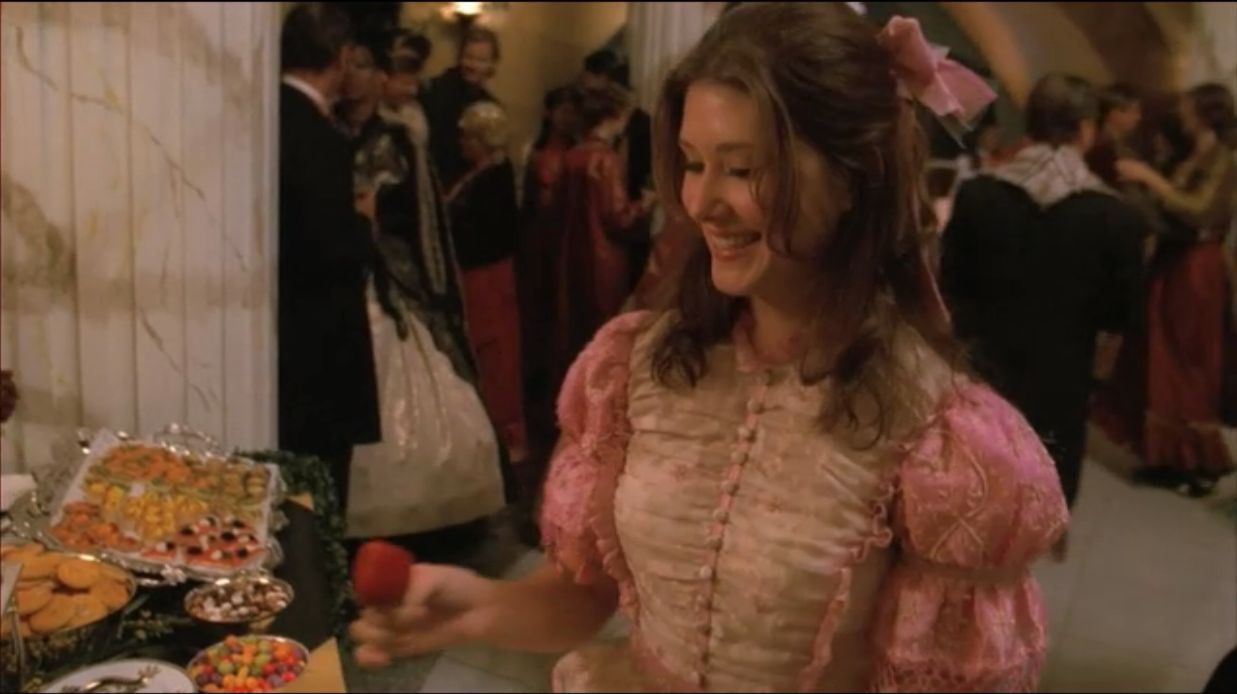
ScottP: The stuff with Kaylee and the fancy dress is entertaining, but the ol’ greasy-tomboy-who-wants-to-be-pretty is an easy way to get an emotional response from viewers and seems a little cheap — although it is fun to watch Kaylee talk engines with the fellas at the party. I was happy to see a nod to her love for strawberries, too.

Tanzi: This is really a character-driven episode exploring the relationship between Mal and Inara, the Badger job is nothing more than a MacGuffin and the rest of the cast quite literally sits on Serenity and twiddles their thumbs throughout the episode. We get to see just how a Companion like Inara operates, how she’s highly in demand and can pick and choose her clients. I have to question her judgement for even entertaining the possibility of being the permanent companion of a touch-hole like Atherton Wing but maybe she really likes these parties.
We also get more insight into Mal’s own personal morality. He had no problem stealing from slavers early in the episode and he’ll call Inara a whore to her face but when Atherton insults her honor he impulsively punches the guy, leading to a duel with swords at dawn. Mal could call upon the crew to rescue him but insists on going through with the duel, even if it means almost certain death at the hands of a master swordsman. Mal would literally die to uphold Inara’s honor, even as he admits it’s Atherton’s culture that dictates the duel, not his own.
ScottD: Good point, and we get here insight not only into Mal’s morality but also his own particular view of honor, and his philosophy. He tells Inara: “You think following the rules will buy you a nice life, even if following the rules makes you a slave.”
I’m with Tanzi — while I can enjoy a good costumed period piece (I’m fond of Oscar Wilde) I have little patience with the exaggerated formalities and ponderous “honor” that comes with nobility structures. At the urgings of a friend, I once attended Court at an SCA event; the rituals and posturing and thees and thous went on for hours, but after 15 minutes I was ready to run amok with a broadsword. (Which, come to think of it, could explain many wars in history.) I simply cannot abide people putting on airs and playing at being lords and ladies.
But then, neither can Mal. So it is interesting to see him interacting with what passes for cultured folks in these parts. We discover that Mal can be polite and even has some background in the culture (he knows the dance) but it is obvious that he is too much of an egalitarian to put up with people who believe they are inherently better than others, part of the “slavery” he was talking about being the idea of a caste system. Inara is fond of telling Mal that he doesn’t get along with anyone; he doesn’t get along with criminals because he doesn’t like to think of himself as one, and we see here that he doesn’t get along with anyone who too highly values their pretension at authority. So a punchup was inevitable.
That the punchup was caused over a perceived insult to Inara puts us firmly back in Western territory: the taciturn cowboy who is unable to tell a woman how he feels about her but is ready to fight over her.
Tanzi: Was it just me or did that silly dance remind anyone else of the similar dance scene in the Val Kilmer classic Top Secret? Of course it’s a standard cliche in the whole 19th century genre but some of the dance moves were quite silly.
ScottD: Interesting you say that! Because the dancing strikes me as sorta clumsy — it looks like the folks had just learned the steps (which was likely the case for the shoot) rather than growing up doing them. I also have the feeling some of the moves were thought up on the spot. Nathan and Morena manage to pull them off pretty smoothly, however. (Though there is one scenario that might explain why most of the dancers are awkward with the steps. If these folks are mostly new to high society, carpetbaggers playing at being cultured, then they might not know the steps. Which would make it very interesting that Mal does. But that’s my overactive-can’t-turn-it-off story analysis module talking. Like Tanzi, I think they look like actors who just got shown the moves, haven’t had much time to rehearse, and are doing their best but come off looking stiff and hesitant.)
The whole party is a Western trope. We’ve established that the Firefly ‘verse is like the South after our Civil War, facing a flood of “Yankees” looking to steal what they can from the defeated Southrons. The Shindig is populated by many of these nouveau-riche carpetbaggers, new owners of estates and property. And Mal is the spunky underdog standing up to these land and cattle barons, ostensibly there to make a work connection but eager to have a chance to tweak their noses. (Yes, cattle barons — Sir Harrow wants Mal to move some cattle, and Lord + dealing in cattle = cattle baron, another nice Western bit.)
Which brings up some more insight into just how wonky the distribution of goods must be in this post-war ‘verse. The contraband we have seen our crew handling so far has been food and medicine; they are now asked to smuggle beef-on-the-hoof. Not rustle, smuggle. What kind of insane tariffs are in place to make it profitable to smuggle cattle? It suggests that there is indeed factionalism between the colony moons, and heavy corruption in Alliance distribution systems. Again, a direct parallel to both our post-Civil War period and the way the Indian reservations were managed (where only about 5 cents out of every dollar actually reached the folks on the rez.)
ScottP: There’s one scene in particular I really like in this episode, and not just because it begins with a slow camera move up the length of Zoe’s bare, sweaty leg: she and Wash in bed, post-gettin’ funky. It’s one of the most natural, honest post-sex scenes I’ve ever seen, with the two joking back and forth exactly like an extremely happy couple would do. It doesn’t feel scripted or phony in the least and it says not only a lot about those two characters but about Gina Torres and Alan Tudyk’s acting chops.
ScottD: It is nice to get to see Zoe and Wash sharing a married-couple moment, and not just because Gina Torres is all love-sweat shiny and making wonderful noises… (Uh, sorry, I was wondering if I left something in my bunk.) Anyway, FOX had a problem with them being a happily married couple; the execs thought them being paired-up-but-unhitched hit a better demographic or somesuch. But Joss stuck to his guns and gave us these folks who are believably happy together.

This scene also gives us some insight into why she and Wash are together: he makes her laugh. At Comicon one year, I got clued in to this effect. There was a booth babe who had every guy there tripping over their tongues and slipping in their drool, a tall black fox in the skimpiest of superheroine costumes not even beginning to cover her world-class derriere; a walking wet dream, an Amazon in the flesh. I just happened (no, of course I wasn’t part of the drooling ring around her, I was just passing by) to be there when her boyfriend came by to pick her up at the end of her shift — she glanced up, squealed her delight, and dashed toward him. I looked that way, expecting to see some male version of her, a superhero supreme in form and face. Instead, the guy she was elated to see was a rather dumpy acned white guy, unprepossessing even by Comicon standards. But they walked away hand in hand, she laughing gaily. This guy would never get on a magazine cover, but he made her laugh.
Just for the record, I am first in line (after Wash and Jayne) to chip in to buy Zoe a slinky dress.
ScottP: Another thing I like is Mal’s readiness to engage in a fistfight with Atherton, then a gunfight when the duel is first mentioned — but when it comes to swords he balks, even though he goes through with it. It’s an interesting bit of business, and in a way, another of those This-ain’t-Star-Trek moments we’ve talked about before: Kirk might not have ever used a Lirpa before but he’s got that sucker down when it’s handed to him. Mal actually has to take swordplay lessons from Inara and he still sucks at it when it’s time for the duel. Again, this is some nice character stuff because we see that despite Mal’s discomfort in his fancy duds at the fancy party, he can hold his own when it comes to dancing (he even tosses out a line about it being a dance he “actually knows”), but a high-falutin’ duel with swords throws him off his game. He can fake a little class except when it comes to fighting. All of this plays nicely off the opening bar fight, too — again, Mal sees defending Inara’s honor as his duty, and is obviously spoiling to rearrange Atherton’s face, but the method of combat completely pulls the rug out from under him.
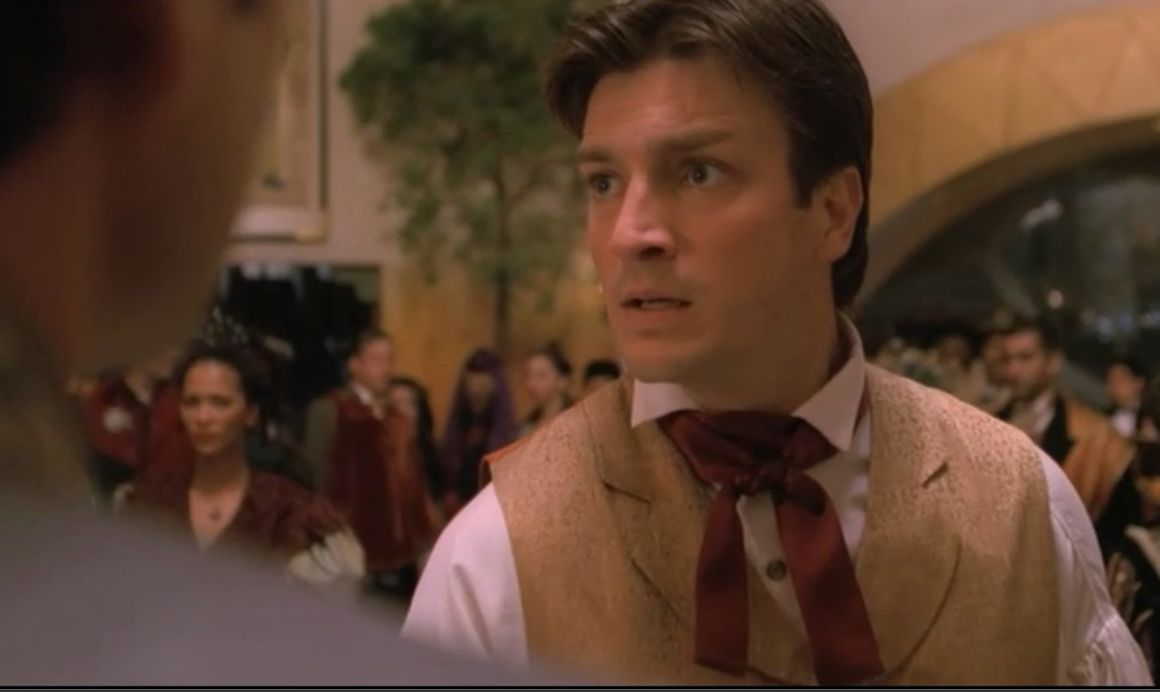
"The use of his what?"
ScottD: The fact that Mal continues on even when he is not sure how to, the odds against him, is a big part of his character. Tanzi mentions that he is dismayed that Inara could even consider going with a sleaze like Atherton Wing. But Wing is arrogant, suave, rich, high status, and wears expensive suits — all things women, the poor dears, are strongly programmed by nature and culture to find irresistible, even Inara with all her training. The fact that “Ath” is everything Mal isn’t (except handsome) plays up the extremes of Inara’s decision as to which world to live in. Mal admits that it’s not for him to keep Inara from being happy, but he can’t keep from trying to save her from someone he recognizes as a “bad” man. In fact, even when Inara offers to save him he stubbornly continues on as though he is somehow saving her, or at least her honor.
As Inara admits, Mal forces Wing to show his true ugly self under the urbane camouflage. That urbane camouflage extends to the whole Shindig. Elegantly dressed men still have to be frisked for guns, the local girls go after sweet Kaylee like yowling cats, and just under the party atmosphere there is a potential for violence just as real as the bar fight that opens the episode. This society has only a veneer of gentility with its strict caste system, need to carry weaponry, and the presence of the code duello.
Not that everyone in this culture is empty or worthless. The older gentleman who slams the girls going after Kaylee proves he has some taste for what’s right, and Sir Warwick Harrow (played by reliable TV/voice actor Larry Drake, perhaps best known as Benny from L.A. Law) proves to be interesting and likeable once we get past the stuffy.
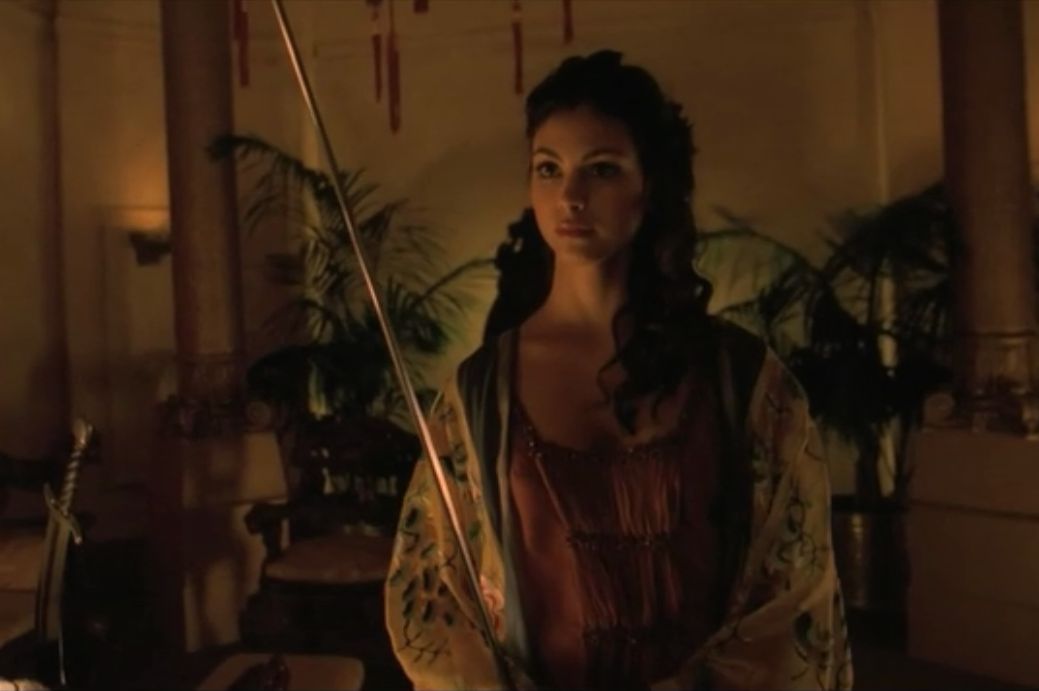 I think of this as the “fencing” episode, the fencing being between Mal & Inara (more romance novel stuff.). They fence while Inara is lining up clients, they fence while dancing, then they fence again (verbally and literally) in Mal’s room the night before the actual fencing match, which after all of that seems almost anticlimactic. (Watching the duel again just now, I realized that some things in this ‘verse truly are alien — there is a tree, for example, that spews morning mist out from its base as though there was a smoke generator hidden behind it. Huh.)
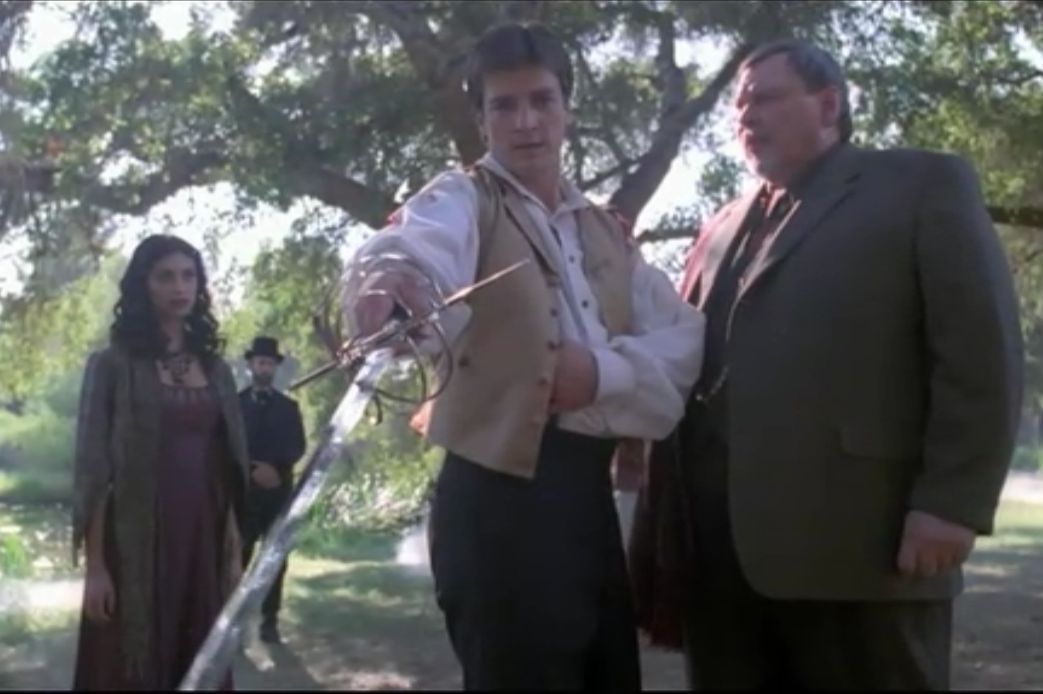
ScottD: Since this episode is so costume-heavy, not just at the Shindig but in the street scenes, I figure this is a good time to talk about the costuming in the show.
I do some costuming, partly for the challenge of getting the details together, partly to have a character to embody (I am an incorrigible ham), and partly for balance — I refuse to wear a daily costume (suit and tie) just for the sake of a job. Which I mention because the Firefly ‘verse has actually strongly affected my daily wear.
Mal’s daily clothes are a mix of ranch, military, and old West. His shirts are practical, utilitarian, like you might see in any of those settings. His pants however are straight out of the 1890s, off-the-rack reproductions of Western pants from that time. I know, because I am wearing some as I write this (minus the added leg stripe that makes his look more military.)
There are several companies that make these pants for Old West re-enactors, most notably Wah Maker and Frontier classics. Wah Maker is a very respected company but they are also pricier, so I am wearing the Frontier Classics. I was looking to do up a Mal costume, got to try some of these pants on at the ranch up the road that hosts single-action shooting events, bought them, wore them for a while and decided they weren’t just for costume, found a place online that sells them, and now I pick some up when they have a sale and they have become part of my daily wear for work.
They are very comfortable, and what’s more they draw lots of attention from the ladies. I even last week had a teenaged girl tell me “your pants are cool” — how often does a 50-year-old guy hear something like that? I notice women lingering around and giving me the eye. The ladies like the tightpants.
And not just the ladies — Zoe wears the same pants as Mal, slightly altered to allow a belt. (Beltloops didn’t become common until 1910 or so.) And you’d have to be dead to miss how those pants accentuate her oh my.
Tanzi: Note to self: buy tight pants. I have to say I’ve admired the vertical stripe on Mal’s pants. Han Solo wears pretty much the same get up, with riding boots and low slung holster. It’s a good look for the fashionable smuggler/charming rogue
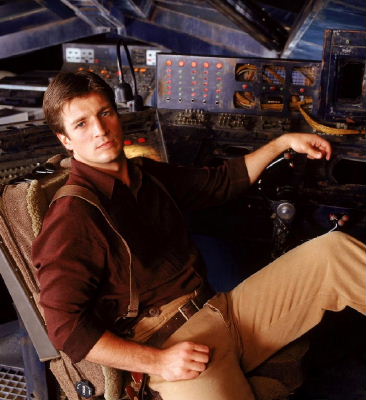
A pinup for the ladies, a model for the men.
ScottD: I’ll send you the link (Wild West Mercantile). Any subsequent female attention is your responsibility.
The old-style pants are the reason for Mal’s distinctive suspender look. The wide suspenders (early on — he wears different ones later, then more “futuristic” ones for the movie) add a military look because they are military, adapted from Israeli army surplus. I bought some online and will soon have some just like Mal’s.
Given Whedon’s stated position about the present being the past sent through a blender, the costume designers for the show had a broad range to draw from. Mal’s “party suit” is Old West with a touch of Edwardian; Inara’s outfit is modified Grecian, and the servants’ outfits look East Indian. But most of the party dresses, especially Kaylee’s, look like something out of Gone With the Wind. Which reinforces the idea that much of the Firefly frontier is like our South after the Civil War.
On a related note, I would like to take this opportunity to present Firefly‘s Chief Lighting Technician Dennis L. Peterson with a Wheel O’ Cheese Award for “Excellence in Cleavage Lighting.” Which of course means another Wheelie should go to Costume Designer Shawna Trpcic for putting Inara’s decolletage out there to be lit. Well done, both of you. You’ve made the world a better place.
Speaking of costuming, there’s a nice bit at the end where we see Kaylee for the first time in a form-fitting top, never before any doubt that she was feminine but now looking more “girly” and curvaceous and cute with grease on her cheek. And she’s all girl as she admires her dress.

There are 2 comments