ScottD: We’re keeping the foot on the gas in our ongoing Big Damn Discussion of the Firefly series. And I am delighted that the three-sided die fell my way to start the review for this particular episode, though I have to say right off that it is a bittersweet experience.
Why the bitter with the sweet? Because I feel that “Out of Gas” is one of the best episodes in the whole series, and what’s more an indication of what the show might have become if it had been allowed to reach its stride and become the Big Damn Series that it deserved to be. So, as much I enjoy this episode, it is the one that most gets me saltily diluting my beer as I think again about What Might Have Been.
ScottP: This is easily my favorite episode of the series, and one that contains several moments that actually cause me to get all choked up and wussified — even after seeing it multiple times. That said, I’m discovering something strange as we go through these episodes: the more I like a particular episode, the less stuff I have to say about it. But I’m with ScottD on this — “Out of Gas” is so goddamn good that it’s heartbreaking to watch, thinking about where Whedon and Co. could have gone with the show.
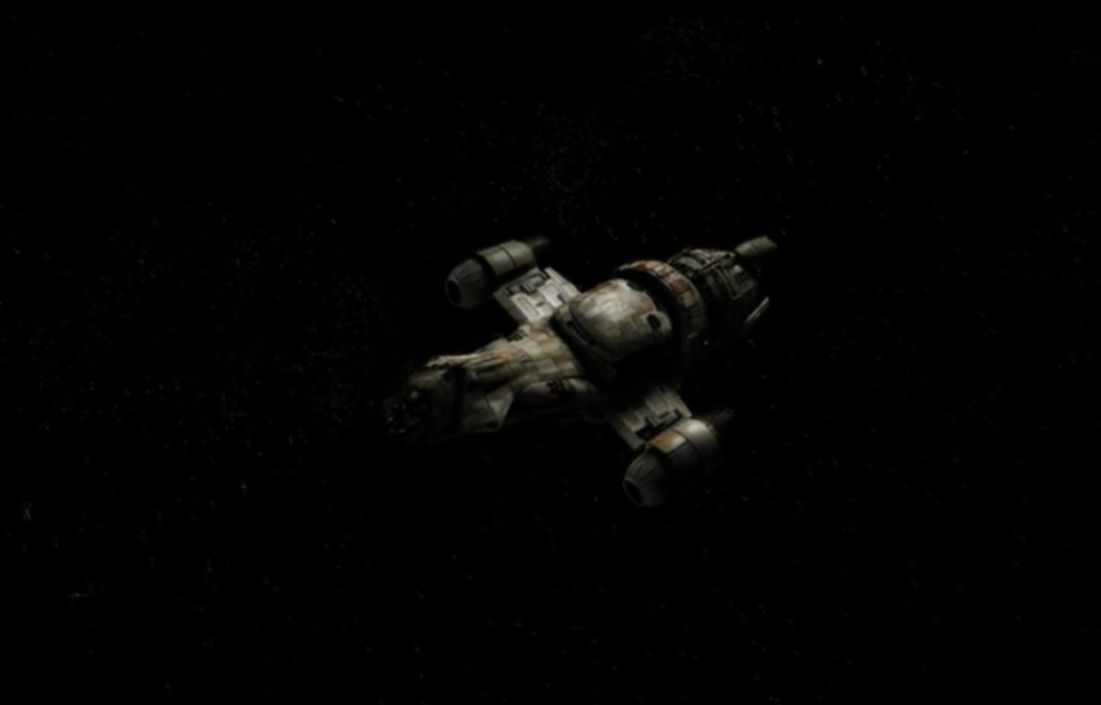
ScottD: “Out of Gas” is a simple premise with a complicated presentation. Poor Serenity suffers a breakdown that shuts down not only her main engine but also what backups there are. Life support is out, they are of course pursuing an “off the map” course, and the crew is faced with some hard decisions. And as those decisions are chewed upon, we jump around through three different time frames and learn more about how the crew came together.
One of the reasons this episode works so well is that is almost swollen with trust. It is obvious that the director trusts the actors to bring out their characters, the actors trust the writers to give them good material, the writers trust the actors to do the lines justice (as the actors trust one another to deliver the lines well), and the director and editors trust the viewers to follow the shifting time frames. This is a level of trust you generally don’t see until well into a show’s second season.
Another reason this episode stands out is that it was written by Tim Minear. We talk a lot about Joss Whedon in these reviews, but Tim Minear is a powerful force of his own, often working in the Whedonverse and working as writer and/or director on many episodes of different series (Strange World, Angel, Wonderfalls, Dollhouse) and as executive producer of Firefly. He brought insight and a practiced deftness to this script, but also a splash of daring.
That Serenity could be “out of gas” points up what we have been shown many times already in the series: life on “the raggedy edge” is precarious, which makes a sense of security or safety even more precious. The calamity that befalls the ship should not have resulted in a life-threatening situation, but their subsistence lifestyle does not allow for luxuries like spare parts or redundant backups for life support. In fact, the problem that our crew faces was presaged in the very first episode, “Serenity”, when folks are disembarking at the Eavesdown Docks and talking about getting supplies:
Kaylee: I’d sure love to find a brand new compression coil for the steamer.
Mal: And I’d like to be king of all Londinium and wear a shiny hat. Just get us some passengers. Them as can pay, all right?
Kaylee: Compression coil busts, we’re drifting.
Mal: Best not bust, then.
To drive the threat home, it was referred to again in “The Train Job”. Mal finds the engine room a spaghetti-wire mess, and finds Kaylee in Inara’s shuttle:
Mal: You’re holding my mechanic in thrall and Kaylee what the hell is going on in the engine room? Were there monkeys? Some terrifying space monkeys that maybe got loose?
Kaylee: No monkeys, mister funny — I had to rewire the grav-thrust because somebody won’t replace that crappy compression coil.
Besides giving us the “space monkeys” line — a bit you are sure to hear referenced anytime Browncoats get together — this scene reminded us again that even for all of Kaylee’s insightful and loving care, Serenity is always one step from being inert because of our crew’s bare-bones budget.
The fact that the threat of breakdown was announced in the very first episode and brought back to mind later shows the big-picture long-term approach of the show’s creators, and is another indication of all of the things That Might Have Been. What other seeds were planted in the early episodes, that never bore fruit? We’ve certainly left a string of enemies behind us, to pop up again as needed. But what other bits did Whedon, Molina, and Minear have in mind that we might have seen in a second or third season, that had their roots in the early episodes?
“Out of Gas” neatly references the compression coil:
Mal: I’m not looking for a ride, Captain. Just a little push.
Walden Captain: Right. Your mechanical trouble. Compression coil, you say?
Mal: It was the catalyzer.
Walden Captain: Not even the coil? Catalyzer’s a nothing part, Captain.
Mal: It’s nothing until you ain’t got one. Then it appears to be everything.
So after all of the setup about the compression coil it is an even more humble, “nothing”, part that lays Serenity low. A nice bit of misdirection.
Tanzi: I didn’t remember the specific part but I do remember the foreshadowing so it was nice to see the payoff. Coming from an IT background I was a little surprised at the lack of spares but I suppose it would have made for a short episode if Kaylee put in a spare and RMA’d the faulty part.
ScottP: It seems like someone (Craig Butler, maybe? If not, I apologize for callin’ you out, Craig) recently griped to me about it being sort of unrealistic for the crew not to be carrying a spare for that particular part. Now, I realize my life isn’t quite as dependent on such things but there are plenty of highly important parts in my old Jeep Wagoneer that I don’t carry spares for and the loss of any one of those would leave me adrift.
ScottD: ScottP has mentioned several times that he would like to spend time sitting around Serenity’s big common-room table with the crew, or at the very least see more scenes with that kind of homey non-action. And Minear delivers that, with an extended scene around the table that is around Simon’s birthday party.
ScottP: Yeah, this sittin’ around the table scene is a favorite of mine. And again, there’s a great Zoe/Wash comfortable-married-couple moment, a complete throwaway that we cut to and away from very quickly: Zoe — proud warrior woman — is resting her head on her husband’s shoulder. Just a tiny bit but as with so many of those moments in Firefly, it speaks volumes. I can’t help but wonder if something like that was scripted or was merely a choice on the part of Gina Torres. Either way, good stuff.
ScottD: Minear uses a device here (which, he reveals in the commentary track for the episode, he is fond of using regardless of the project) where each of the character’s basics are restated: it is mentioned that Simon is a doctor and a fugitive, that Wash and Zoe are married, Book is a preacher, etc. Minear says that he feels it is a good idea to do this periodically, to help ground folks who have just tuned in to the series. (ScottP tells me this device is also often used by comic book writers, over long story arcs.)
Another thing this scene does is to show us the crew as family; even Jayne and Simon are for the moment getting along,
and Mal allows himself a little fatherly smile that the family is together.
All of which raises the stakes — the more the crew laugh together, the more it exaggerates what they might lose due to the coming threat.
Director of photography David Boyd added not only ambiance but also some visual cues that we are in flashback by shooting the scenes from the past on color-reversal film, which gives a very saturated “summery” look to everything.
Care was taken that Mal looks younger in these scenes, with a slightly different haircut. But honors for bringing out the past have to go to Wash’s mustache, which was evidently a choice insisted upon by Alan Tudyk. (And referenced in a blooper reel scene I need to track down — reportedly, when Wash turns around Mal and Zoe are wearing similar mustaches.)
Tanzi: The mustache was indeed an inspired choice. I got a kick out of Zoe’s instant dislike of Wash. She couldn’t come up with a specific reason but you know that horrible soup strainer gave her the creeps.
ScottP: Yeah, I think it was the ‘stash, too.
ScottD: Something to watch for here are the nice transitions between the flashbacks and the present-moment scenes. Many times there are visual references, lighting & positions of people, that link the before with the now, like Mal with his hands up for the Walden crew and then for the flashback with Jayne. This is evidence of some very slick directing and editing, but what is more is an indication of the overall care the production crew brought to this show. Anecdotes abound regarding how everyone involved in Firefly, from scripting to costuming, from lighting to sound, from directing to editing, cared very strongly about putting out high-quality product. But we don’t have to turn to anecdotal evidence, the proof is right there on the screen — this is a bunch of people happy to be on board the project and doing quality work. And I have to ask again: if the production crew was turning out work this sweet after only a few episodes of working together, what would they have given us after they got a chance to really learn each other’s dance moves?
Speaking of moving around in time, there is a wonderful little bit that shows the influence joining our crew has had on Jayne. In the splendid flashback sequence where we first meet Jayne he is even cruder than we know him to be, and prominently dirty. Yet in the birthday party sequence he is wearing a napkin, and cleaning his teeth! Rudely at the table, of course, but still something the old Jayne likely would have never thought to do.
Tanzi: I was hoping we’d see Jayne with his old partner from the Jaynestown heist but instead we get a couple of generic dirtbags. Later in the episode, when air is running out and Mal is arguing with Wash, Jayne tells them to stop fighting and wasting oxygen. You know you’re in deep shit when Jayne is the voice of reason.
ScottD: You know you’re in deep shit when Jayne is the voice of reason. OK, that one’s going in my quote file. You made me spew my tea!
ScottP: I also like that, despite their sometimes adversarial relationship, Jayne’s concern for Mal is obvious when the crew is leaving him behind — Jayne’s comment that he prepped a suit for the Captain and the look on Adam Baldwin’s face as he turns to leave are nice bits.
ScottD: In “Our Mrs. Reynolds” we got to see more of Serenity as a ship and as a character in the series. That is continued in this episode; Kaylee speaks of the ship as a person that she has let down:
"I shoulda kept better care of her. Usually she lets me know when something's wrong. Maybe she did and I wasn't paying attention."
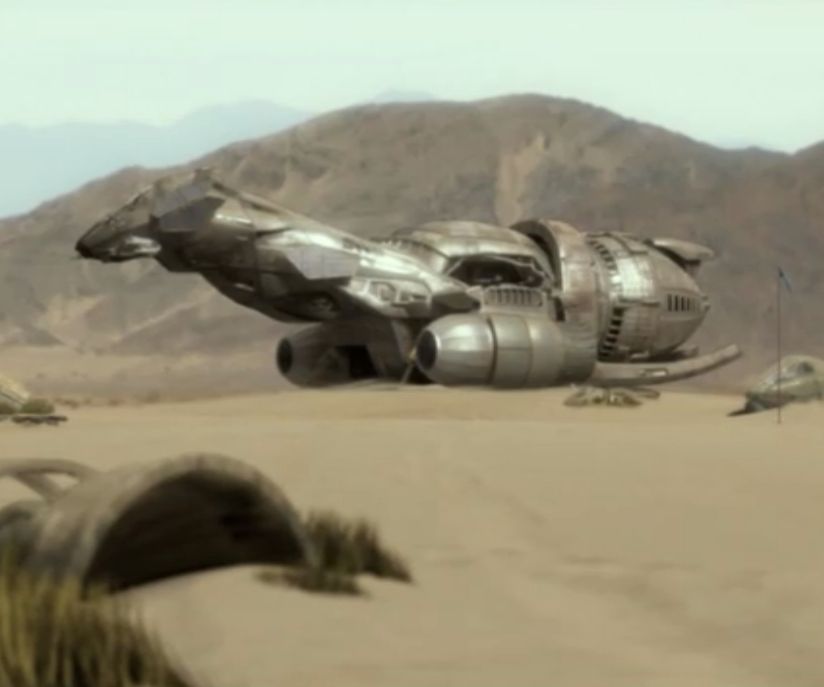
Serenity may be petite as spaceships go, but as Mal makes his way through her she seems very large indeed, large and echoingly empty.
ScottP: For some reason, seeing Serenity drifting in space with debris floating around her really gets to me, as does the final shot in the episode.
ScottD: Another thing that gets me thinking about What Might Have Been is how this episode brings us interaction with another crew. We get the idea that there are lots of crews like ours out there, salvaging & scavenging, scraping by, doing whatever is necessary to make it through. But obviously some crews are more ruthless than others:
When there was talk of doing a series of tie-in novels for Firefly, I had several ideas for books to pitch. One involved our crew working with another ship to do a job, only it turns into an us-or-them situation. The heartbreaking part is that the two crews are very similar, in some ways mirror images, so having to destroy the other ship is almost like destroying Serenity. The crew of the S.S. Walden is a lot like what I had in mind. I think the gun-toting femme might be a female version of Jayne, and my oh my wouldn’t we like to see how that played out? Lots of ships out there, lots of opportunity for stories.
And then of course there is the “first meeting” scene with Kaylee. I’ll say it again: Kaylee is so sweetly innocently honestly sexual that she is a breath of fresh air in a smoky female ‘verse. She is the antithesis of all the anguished self-doubting or predatory and manipulative femmes we so often see on TV; in fact, whenever I happen upon an episode of Sex and the City — a show which I have advanced beyond dislike to actual resentment, for the trips it lays on women about how they have to act to be happy — I think of sweet glad-to-be-alive Kaylee as a counterbalance and antidote to that show’s subtle poisons.
Tanzi: Wow, that was quite an entrance for Kaylee. Sweet little Kaylee, boning space Spicoli in the engine room. I thought they laid it on a little thick with Kaylee never having been on a ship before but I understand the need to establish her as a mechanical savant with a few lines.
ScottP: I like that Jewel Staite didn’t play Kaylee as particularly embarrassed in this scene, just a little shy — and not so shy that she isn’t quick to point out how wrong space Spicoli is about Serenity‘s engine. And Kaylee makes some mighty nice grunts and squeals, not for nuthin’.
ScottP: I feel compelled to mention that eight episodes into the series, I still have yet to spot the far-fabled “Han Solo in Carbonite” that’s apparently hidden in each and every episode.
ScottD: I may have to turn in my brown coat, but — I’ve never spotted it either. I always tell myself to watch for it, then I get so caught up in the story I forget. And I refuse to hit a fansite that lists them — I’m gonna earn ’em all honest like.
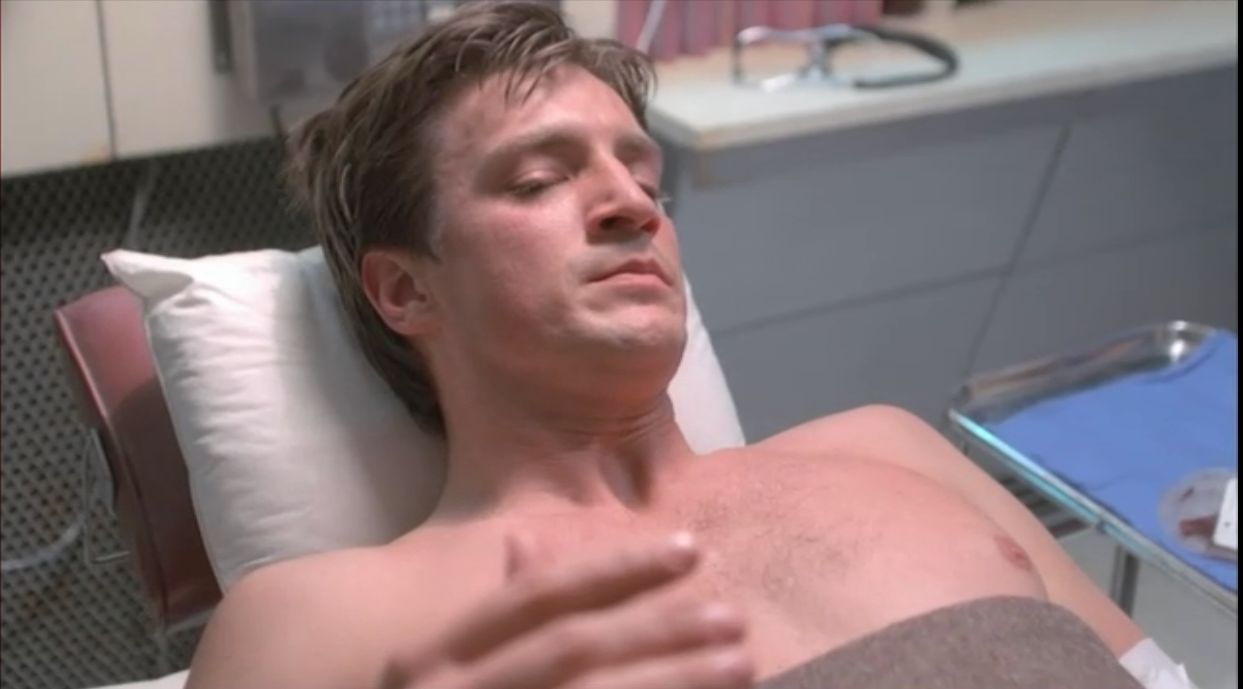
“Tell you what — you buy this ship, treat her proper, she’ll be with you the rest of your life.”
There are no comments